Bibliosentience, the primeval synapse
research (2026)
An Ode to Cadavers
reading score (2025)
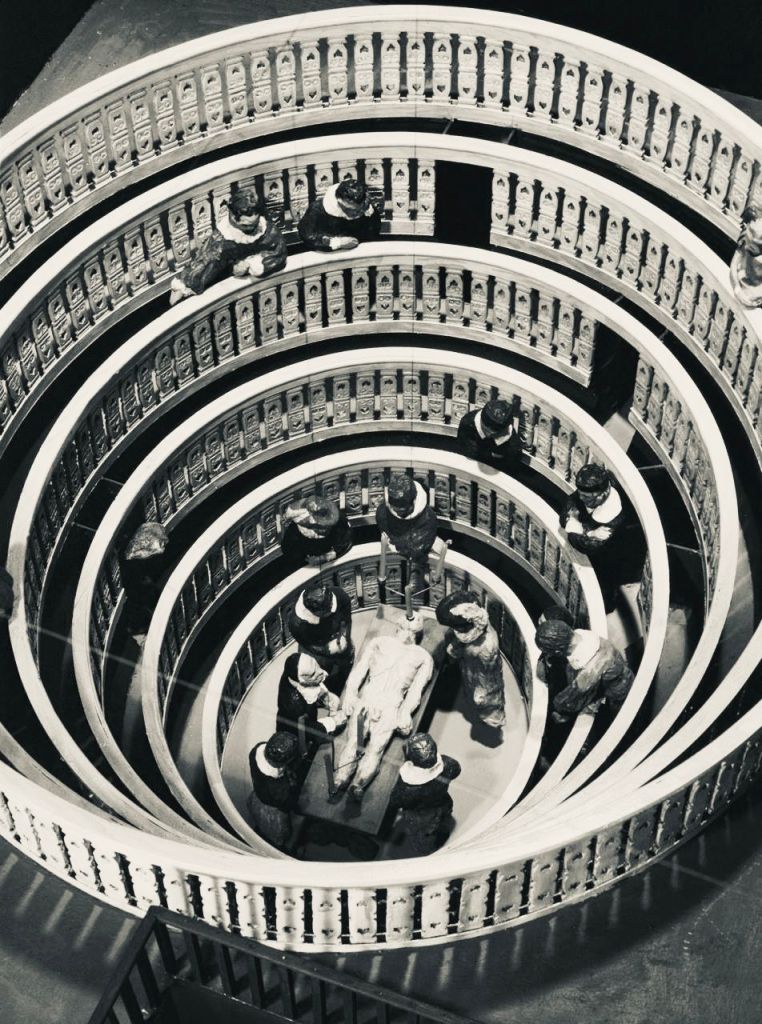
The lintel inscription of the Anatomical Theatre at the Università degli Studi di Padova reads: MORS VBI GAVDET SVCCVRRERE VITAE or Where death rejoices to help life.
But –how exactly life and death collaborated? Inside stands a pedagogical structure where the eyes meet the hands, craft entwines science, so that the living may follow the light falling upon a cut-open body. Anatomical theatres were designed to allow the trainees to see the dissection and hear the professor’s commentary, so they were chambers of concentration as much as of spectacle. These dead pedagogues were typically executed criminals or unclaimed individuals whose death rejoiced life through the method of dissection and taxonomy-driven description, and that the canons were forged and have become the dominant discourse on the anatomical body that endures to this day.
Ode to the Cadavers is a reading score to revisit a double ritual of anatomical theatres: the ‘profane’ ritual of scientific knowledge on the body and the ‘sacred’ ritual’ for those who regard the human form as a divine image. It first questions basic assumptions of the body and asks what might have slipped away under the light of the empirical method? How did the act of looking and of naming participate in constituting the canons on the anatomical body as we understand it today?
Beyond the historical reverberation of Anatomical Theatre in the present time, Ode to the Cadavers addresses a shared politics of bodily erasure that persists in contemporary culture – a continuum that stretches from the purely mechanical body to the sanitised spiritual body. As biomedical reductionism and marketised spirituality draw from extractive epistemologies that translate bodies into data, images, or consumable affects, the reading score is an attempt to invite stories of what has actually been occluded.
Marginalia on ‘Incubation’ (who tends to words that tend to art?)
criticism (2025)
Critics need more than ‘a platform’. They need conversations — someone who talks back, challenges, dwells with the text. Despite claiming to ‘redefine the role of art criticism in the digital era,’ the project amounted to little more than routine descriptions of artworks — too inert to provoke, let alone redefine, anything. […] How about a critic starts asking: what does it mean to continue to write art criticism in THIS ERA if it simply generates a descriptive, derivative text, in the way GenAI could tirelessly produce? What is the point of writing in this time if words don’t breathe, tremble, stutter, in the manner that only living organisms can do?
[…]
To tend to the practice of art criticism, it needs time for discernment through ways of looking inward–outward, of thinking back–ahead. Without generosity of time, art critics cannot prosper.
Just like the meme satirises how people broadcast the man, while keeping him stranded on the barren island as ‘content’, the absence of art criticism is a familiar lament in many parts of the world, yet scarcely given the close, patient attention the practice needs to take root.
criticism (2025)
The tired dichotomy of “art” vs “non-art,” or “art” vs “mass,” rests on a smug assumption that the former is inherently more sophisticated. Ironically, even those who critique this hierarchy often end up reinforcing it by arguing from within the same binary. Likewise with art criticism, a flat, dull kind of writing exists in both academia and pop media, while bubbly, merry tones don’t necessarily reach “the majority” as claimed either.
[…]
Art experience often occurs outside the semantic zone, like horror that exists at the edge of the utterable. A neat justification based on theoretical, sociopolitical, philosophical context is the secondary message—the weaving process of a critic. So I believe art proves its meaning when it invokes experiences that are incommensurable, in a way we can’t access elsewhere. Or perhaps, it disturbs what we think we know, unsettles our preconceptions, or urges us to revisit what we take for granted. In this very same sense, shouldn’t art criticism be a way to open a door for meanings, instead of restricting them?
[…]
For me, a report on the place where one works and lives is also a binding gesture of a critic’s inner landscape—or “(sub)liminal zone” where lived experiences may reconfigure or fall apart. Though the contemporary exhibition readily adopts the rhetoric of “diversity,”11 criticism seems to remain confined in a narrower circle. In this situation, why don’t critics continue reporting on how art is felt, understood, and spoken, however minor its impact may seem, until what we call “art criticism” no longer mimics the old, singular formality, but instead creates from wherever a critic stands?12
A Confluence of the Three Mermaids
research on oral storytelling (2024-2025)

There is a little-known yet enigmatic story retold in Bangkok’s old riverside community, of an old woman who encountered three mermaids right behind her apothecary and her house in countless moons ago. Once I looked into the official archive, there is zero evidence about the encounter between the old woman and the three mermaids, but it has instead been circulated amongst local people as ‘a horror story.’
I then realised how the memory of ‘wonder’ has turned into ‘horror’ when humans cannot deal with ambiguous experiences, or perhaps, when we have lost our capacity for enchantment altogether. The archive, in this sense, is not a home for mythical beings, nor a dwelling place for inexplicable experiences that resist empirical evidences.
A Confluence of the Three Mermaids is a collection of fragmented stories about the three mermaids with no attempt to consolidate those remains. It chooses to listen to the scream of three mermaids buried underneath the narrative of water monsters, and to shift into a space where the mermaids can return their gaze, witness, and imparts their memories.
♮hʌm fər həʊm
melodic memoir (2024)
This short writing (22 pages) traces a long walk toward understanding what it means to arrive home after dealing with loss in all different names. It had cost me dearly to recognise what I’ve inherited: the unresolved emotions passed quietly down through blood and bone. The first draft came out in one sitting, perhaps, almost like a one long exhale — and then I kept returning to revise it until the end of 2024. Somewhere in that slow process of writing and editing, I came to understand how the acts of remembering and reweaving could slowly unbind the weight of transgenerational memories unconsciously buried in the threads of grief, longing, and belonging. I also proposed ‘double negation’ as a kind of movement through the text which negates both the conventional and counter perception of what it means to be ‘liberated.’
Boundless Bodies: anecdotes & antidotes
memoir (2019-2023)
A 5-chapter memoir [The Feet; The Sea; The Garden; The Dictionary; The Storyteller] for my father and the countless lives we both have touched and been touched by.
The term ‘Boundless Bodies’ first rhymed on my tongue in 2019. It was the period of contemplation on transgenerational and unresolved memories. This humble approach has since become the foundation of my work, for It has guided me to excavate what remains until it transforms anew.
[…] this writing starts from both of us and traverses many anecdotes, encounters, books, animals, and people whom you and/or I have met and engaged with in diverse forms of interaction. Apart from the act of remembering, this writing also serves as portals to relevant discourses based on lives enriched by perspectives and reflections to those who lived before you, beside us, or will live after me. So, here, I can only learn to speak while learning to keep silent, learn to write while hearing the unspoken.
 Judha Su